Thursday, November 3, 2016

Melania Trump rails against the social media bullying her husband, his fans love

Https%3a%2f%2fblueprint-api-production.s3.amazonaws.com%2fuploads%2fcard%2fimage%2f271459%2f81b785f03fe844ce80b50cf6429af531
Feed-twFeed-fb

For someone who apparently hates social media bullying, it doesn't appear Melania Trump knows Twitter as well as her husband. 


Melania on Thursday spoke out against social media bullying in her first campaign speech since the Republican National Convention. And though the context of her speech was mostly geared toward protecting children and teenagers from online abuse, her words could just as easily have been directed at some of her husband's most outspoken supporters. 


"As we know now, social media is a centerpiece of our lives. It can be a useful tool" she said in Pennsylvania. "But like anything that is powerful, it can have a bad side.”  Read more...

More about Nazi, White Nationalism, Bullying, Social Media, and President


Boosting B2B Leads by 9x with PPC and Landing Page Best Practices [Case Study]

b2b-ppc-lp-best-practices-blog

Send your conversion rate soaring with landing page and PPC best practices. Image via Shutterstock.

Do you ever dream about increasing your conversion rate? How about increasing it by 290% and boosting your lead generation by 9x?


Well, that's exactly what we did for our client, Revecent, a company specializing in sales consulting and recruiting. The results were so dramatic, they asked us to scale up the campaign less than a month after initial launch!


Today, I'm going to show you exactly how we did it, and how you can achieve the same results by following key PPC and landing page best practices.


Ready to start making more money than you ever thought possible from your B2B PPC campaigns? Let's dig in!


Identifying the issues


Most B2B PPC campaigns have poor conversion rates and ROI. This usually happens because the campaign is not set up using best practices, is not managed using a disciplined process and does not use optimized landing pages. In fact, 52% of B2B PPC ads still point to home pages.


Indeed, when we first looked at our client's old Google AdWords campaign for recruiting services, we saw each one of these issues at play.


before-campaign

Revecent's overall conversion rate of 2.83%, while above average for a B2B campaign, was nothing to write home about. And the high cost per conversion didn't produce many quality leads, thus preventing the client from scaling up the campaign.


While there were many issues, we focused on four key areas for our plan of attack:


  1. Poor account structure

  2. No targeted landing page

  3. Wasted ad spend

  4. Inadequate keyword management


Let's dig into each with more detail…


1. Poor account structure


One of the biggest issues in the campaign was that they had only three ad groups with 40 to 50 keywords each. This resulted in poor quality scores and poor message match between ads and keywords. Here is an example of one such ad and the variety of different keywords that trigger it:


Sales recruiting keywords

Your ads (and landing pages) can never be relevant for so many different keywords. Ideally, you should strive for a 1:1 ad group to keyword ratio for keywords expected to drive at least 80% of the traffic to your campaign.


Not sure how to spend your PPC dollars?

Steal Unbounce's spreadsheet so you can become more campaign driven and begin spending wisely.

By entering your email you'll receive weekly Unbounce Blog updates and other resources to help you become a marketing genius.

2. No targeted landing pages


Rather than develop specific landing pages for the campaign, the client chose to use one of their service pages as a landing page. As you can see below, it had a number of issues including conflicting calls to action, multiple navigation links and some pretty blasé content and design:


Revecent service page

3. Wasted ad spend


Even considering their modest budget, the campaign was very inefficient - only 10% of the keywords had conversions, and 90% of the conversions came from 30% of their total ad spend.


4. Inadequate keyword management


Revecent's existing campaign used mostly general and high-level keywords, rather than niche and long-tail keywords.


Keywords with specific job titles, industries and geographic locations were notably absent from the campaign. Because of this, Revecent's ads were generic and not customized to the user's search queries, which resulted in poor performance.


Additionally, while Revecent did add a few negative keywords when they first launched their campaign, they did not monitor their search terms on a regular basis to add new negative keywords. Ideally, this should be done on a weekly or bi-weekly basis to improve the quality of traffic.


Implementing the solution


We came up with a three-step plan to optimize the PPC campaign: (1) Use best practices to structure the account, (2) create conversion-optimized landing pages and (3) use a disciplined process to manage the campaign and realize ongoing improvements.


1. Use PPC best practices to set up the campaign


First, we spent time understanding the client's business in detail - going through their services, industries they serve, ideal customers and competitors.


For context, the client provides sales recruitment services to small and medium sized B2B companies located in major metropolitan areas across the US. The industries they cater to include software, technology, real estate and B2B services. Based on this information, we conducted extensive research to identify some quality keywords for their campaign.


Using the Google Adwords Keyword Planner, we identified the best keyword opportunities including niche keywords around specific industries like software, SaaS and technology, as well as keywords containing metro areas like Chicago, NYC and San Francisco.


We poured through the Search Terms Report from the client's old campaigns and extracted some excellent keywords as well as a host of negative keywords. We also used the SpyFu tool to look at which keywords competitors were using, and then extracted some of those as well.


Next, we set up an account structure that would give us a solid platform for the campaign. We created a structure where keywords accounting for around 90% of the expected traffic to the campaign were placed in single-keyword ad groups. This resulted in about 80 ad groups.


Our approach would give us the most control over the campaign, ensuring precise message match between keywords and ads, high quality scores and click-through rates, while keeping keyword cost per click at a reasonable level - even for the top three ad slots.


Below are three examples of the ad groups we created.


Ad Group Sales Recruiters Dallas:


Sales recruiters Dallas ad group

Ad Group Software Sales Recruiters:


software sales recruiters ad group

Ad Group Sales Recruiting Agencies:


sales recruiting agencies ad group

We rewrote all the ad copy to properly convey the client's main benefits with lines such as “Build an All Star B2B Sales Team” and “Targeted & Vetted Candidates Only.” We also added sitelinks, callouts and call ad extensions.


Finally, we added a number of negative keywords in each ad group to make sure that any keyword searched on Google would only match one ad group. For example, in our “Sales Recruiters” ad group, we added “Dallas”, “Software”, “Agencies” and a host of other terms, as negative keywords.


2. Create conversion-optimized landing pages


We created a new landing page in Unbounce starting with the 5-Elements template. We customized the template based on the client's brand, added original copy and then made tweaks according to best practices for landing page design.


Original optimized landing page

Some of the best practices we employed on the landing page were as follows:


  • Tagline below logo emphasizing focus on Sales Recruiting

  • Phone number integrated with Google call tracking so we could track phone calls being made from this page

  • Real customer testimonial

  • Prominent above-the-fold form

  • Clear call to action and animated arrow to attract attention

  • Customer logos to build trust

  • UTM parameter tracking using hidden form fields to capture the campaign, keyword, device and keyword match type


We also created a headline and subheading that effectively described what the client does and what the main benefits of the service are.


Instead of creating multiple pages with content customized to associated ad groups, we opted to use Dynamic Text Replacement to change the content of a few key areas of the landing page. Using this approach, we were able to change the entire headline based on which ad the user clicked on. We also used Dynamic Text parameters for a portion of the subheading and section headings.


For example, below is the ad copy for “Software Sales Recruiters”. The bolded, italicized portion represents the dynamic portion of the ad.


  • Headline: Hire Top Notch Software Sales Professionals Today

  • Subheading: We recruit the best software sales professionals in your industry. Candidates are assessed based on 21 sales specific skills common among top 20% performers to ensure success.

  • Section heading: Outsource Your Sales Hiring to Expert Software Sales Recruiters


Once we had our account setup the way we wanted and the main landing page ready to go, we launched the campaign.


3. Do ongoing optimization and A/B testing


Even if you use best practices to set up a campaign, things may not always go as planned. Real-world performance can throw a few curve balls.


In our case, while we did find that our campaign was performing a lot better than the old campaign, there were a few things that needed to be adjusted.


Negative keywords


One of the first things we found was that the campaign was getting lot of irrelevant traffic. We identified several search terms for industries the client did not serve; for example, medical and pharmaceutical.


We also found search terms that referenced services the client did not provide, such as IT recruiting. There were a number of informational search queries as well which were not ideally suited to our campaign. So, we went into the Search Terms Report in AdWords and added these as negative keywords. You can see examples of some of these below:


excluded-keywords

New keywords


On the other hand, we found dozens of new keywords that people were searching for that we hadn't used in the campaign. We added these keywords into new ad groups in the campaign to maximize their effectiveness:


new-keywords

A/B testing


We started out with two ads in the ad groups receiving the most traffic and continued to A/B test until we found a winner. Then, we created a new variant and tested that against this winner and continued this process to improve click-through rates.


We also created a variant of the landing page using the Forward template in Unbounce. With this landing page, we tried a different CTA and a different headline that included a number (as these tend to perform better).


revecent-original-lp

Bid optimization


We employed a manual CPC-based bid strategy throughout, because that gave us the most control over the bidding process. We also monitored and optimized bids regularly to maintain a top three average position with most ads.


Lead quality


Our client wanted to make sure that we minimized leads from job candidates. They also were not interested in getting leads from companies looking for part-time help or commission-only sales reps.


Most leads specified what they were looking for in the description box on the form. We used this in conjunction with the search term used by the lead to identify keywords that were responsible for such leads. Based on this, we would either pause those keywords or modify the ad copy.


The Results (and the payoff)


As you can see in the table below, our new campaign performed exceptionally well compared to the old campaign. We were able to realize immediate performance gains and, because of the low cost per lead, the client asked us to scale up the campaign quickly.


campaign-results

In all, the new campaign was able to:


  • Reduce cost per conversion by 78% - from $183.13 in the old campaign down to an outstanding $39.85

  • Improve conversion rate by 290% - from 2.83% to 11.04%, which is outstanding for a bottom-of-the-funnel B2B offer

  • Boost conversions from 33 to 308 in the same time frame

  • Improve the lead-to-opportunity conversion rate from 10% to 25%


We achieved our results by following best practices for campaign setup and landing page design and by employing a disciplined process for ongoing optimization after the initial launch.


Although it took a considerable amount of time to set up the original campaign structure, this approach allowed us to get the perfect search term + ad copy + landing page message match. In the end, we were able to create a solid, highly scalable platform for sustained growth.


Wednesday, November 2, 2016

Facebook's mobile business is bigger than ever

Https%3a%2f%2fblueprint-api-production.s3.amazonaws.com%2fuploads%2fcard%2fimage%2f270210%2fap_97136768370__1_
Feed-twFeed-fb

There's a good reason why Facebook's mobile business is bigger than ever.


The majority of Facebook's users now access the social network exclusively on a mobile device, Facebook announced as part of its third quarter earnings. 


Of its 1.79 billion monthly active users, more than 1 billion are so-called "mobile only" users who only use Facebook on mobile devices. And, by all accounts, it looks like that number is only going to get bigger.


How people use Facebook – over 1 billion mobile-only, ~600m mobile+computer, 130m computer-only. Mobile-only 8x computer-only pic.twitter.com/YDuLTWafk1


- Jan Dawson (@jandawson) November 2, 2016 Read more...


More about Mobile, Social Media, Facebook, Apps And Software, and Tech


ABC News, Facebook Live Gear Up for Election Day

ABC News will continue to incorporate Facebook Live into its coverage of the 2016 presidential election on Election Day itself.


The partnership between ABC News and Facebook Live resulted in 28 million video views during the Republican National Convention and Democratic National Convention and 24 million during the three presidential debates and one vice presidential debate.


On Election Day, Nov. 8, ABC News said its curated Facebook feed will feature livestreams from anchors and correspondents throughout the day at key polling locations and candidate parties, as well as commentary from ABC News Election headquarters in New York. Comments, questions and conversations from viewers via Facebook will be incorporated into coverage.


Anchored coverage will begin at 7 p.m. ET, with Nightline co-anchor Dan Harris, anchor Amna Nawaz and contributor LZ Granderson, as well as other ABC News contributors and political voices, including analysis from FiveThirtyEight.


Also in New York, Good Morning America co-anchor Michael Strahan and correspondent T.J. Holmes will report from Times Square Crossroads on the latest polling results and analysis, and ABC News and Facebook Live will present a booth in Times Square where voters can voice their opinions.


Facebook-owned photo- and video-sharing network Instagram will also host a #MiniOval at Times Square Crossroads, where visitors can take photos inside miniature versions of the Oval Office.


Readers: Are you ready for Election Day?


7 Lessons from Top Performing Drip Email Campaigns

Automated email workflows can net you 20% more sales opportunities.


They're more personalized, timely, and targeted.


The problem, is that the vast majority of marketers – as high as 85% – are unhappy with their performance.


Not the results of those campaigns. But of their own execution or implementation of them.


Instead of rehashing the same onboarding campaigns from the same companies that others have covered well, I spent a Sunday morning digging through my inbox to find examples from different industries. (Sounds like a fun weekend, right?!)


The objective, was to pick out different campaigns at random that were each utilizing different personalization techniques to give you a fresh approach and hopefully inspire new ideas.


Here are seven (plus one special bonus) to emulate, research, and try for yourself.


1. Time Etc. Specific Task Spotlight


Tell me if this sounds familiar.


You find (or hear) about a new amazing service.


First pass, it looks awesome. So you sign up, mess around for a few minutes, and… ?


You hit a wall. A blank. And you're not sure what to do next.


There's a reason the vast majority of free trials (~50%) don't turn into free accounts. People aren't sure what to do next, and they haven't seen that 'first win' yet.


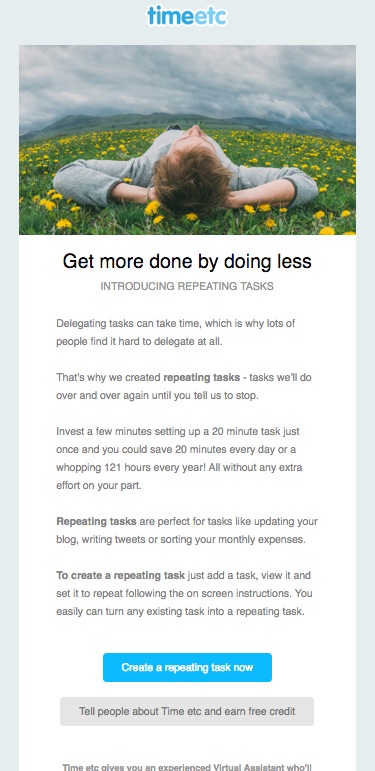
UK-based, virtual assistant service, Time Etc., sends an early task or feature highlight to new sign-ups who haven't used the service yet. The goal is to avoid this decision fatigue by helping to prompt people with specific ideas for what to do next.


For example, this one focuses on creating a new repeating task.

time-etc-repeating-task-email


The single column email is just long enough to provide context to a user, before expertly using a primary (create the task now) and secondary CTA (learn more) to get started.


The hope, is that these leading emails can jog some ideas in those reading it, getting them thinking about ways around the initial problem that blocked them from taking the first critical step in the first place.


2. Rock & Roll's Event Repurchases


The Rock & Roll Marathon Series has grown from humble beginnings in my beloved San Diego, to now stretching out across most major U.S. (and some European) big cities.


They now regularly feature 30,000+ attendees running urban courses with bands, DJs, and more every mile or two of the half and full marathon routes.


As anyone's who's thrown an event can tell you, they rely heavily on early sign-ups (even at discounted prices) and repurchases (from past happy attendees) to help forecast and make up for the fact that most will wait until the very last second (and they've already shelled out the money to organize everything upfront).


That brings up two key segmentation features:


  1. By Location

  2. By Event


Let's start with the basics:


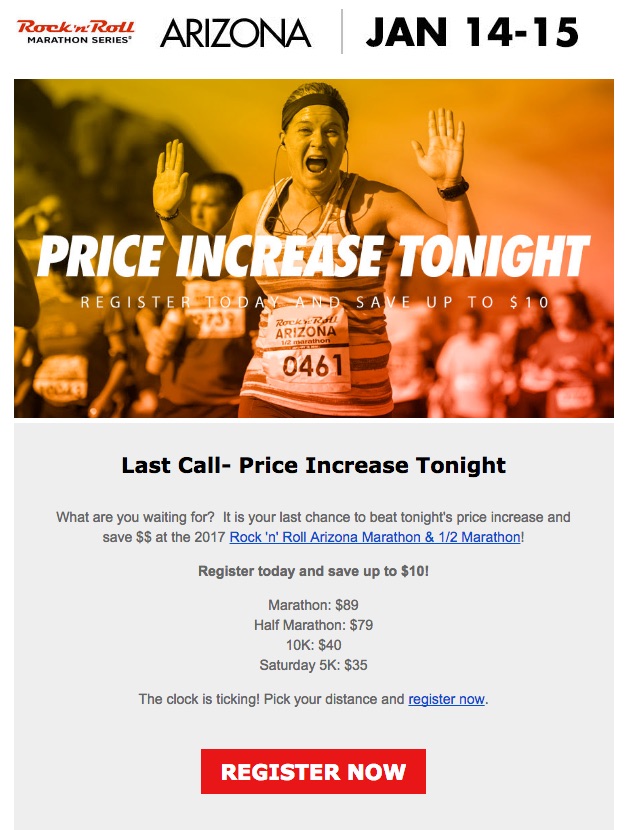
rock-n-roll-marathon-arizona-email


The first example highlights a simple event segmentation, sending a scarcity-based promotional message that would make even Cialdini happy.


This one's relatively straightforward, relying on the urgency of an early pricing discount expiring to be the entire messaging.


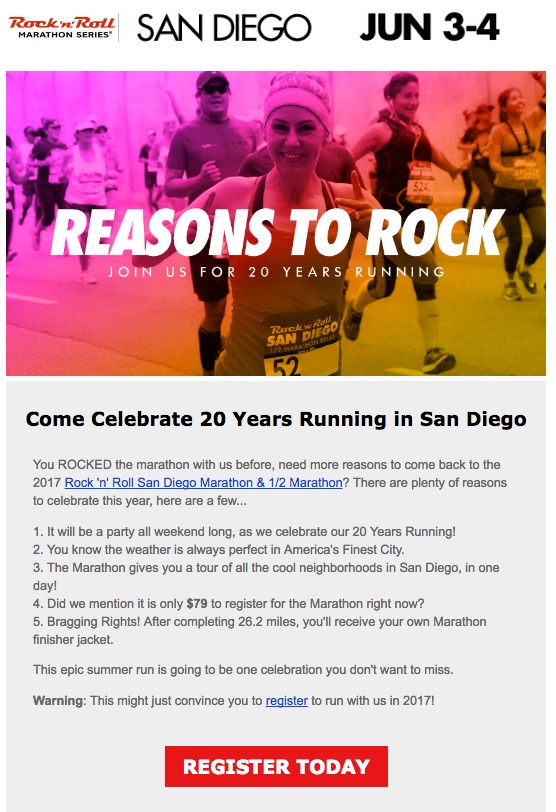
The second is slightly more nuanced.

rock-n-roll-marathon-san-diego-email


This one is pulling in the (1) event and (2) location details to inspire (and hook) those who just completed that specific event in that specific city to repurchase.


Receiving these, in a succession of months, with the aforementioned urgency-based price increases, are like a war of attrition that slowly but surely whittles away a large list to capture as many early purchases as possible.


This example, along with the Time Etc. one before it, was relatively basic time sensitive examples (where campaigns are sent X days out from Y trigger).


Time to get a little more sophisticated.


3. Expedia's Recent Booking Abandonment


A hotel booking process is no different than an eCommerce checkout one when you think about it.


A sample of people begin the process, selecting dates (like products) to see how much the grand total might be, before getting distracted (or jumping over to a different product or website to compare prices) and leave the site.


The statistics are also (unfortunately) similar. While as many as 67% of eCommerce people might abandon a cart, 81% of people booking a hotel or travel might bounce as well.


The good news is if this user's logged in, you can track and react.


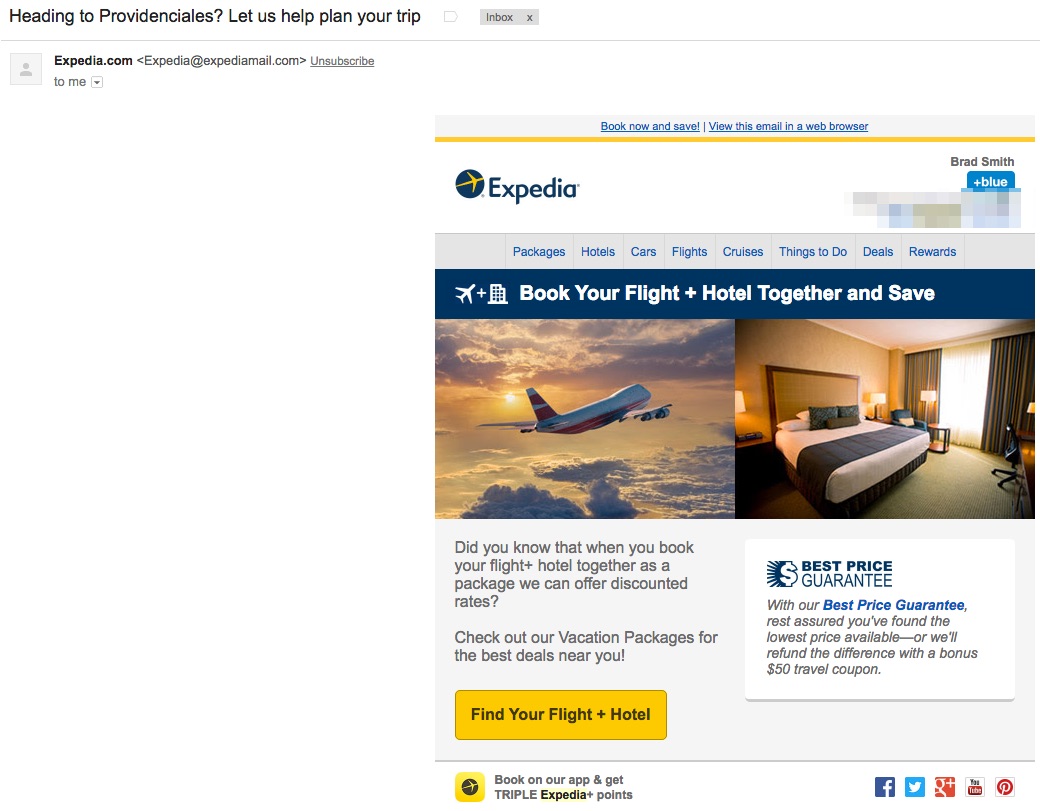
Case in point: Expedia sends these behavioral, event-based messages shortly after searching for hotels in specific locations.


The first example pulls in the specific city name in the subject line of the email, while the body copy tends to be a little more generic, focusing on the 'upsell' of booking an entire package vs. just selecting a hotel.

expedia-recent-booking-email


The second, features a subject line that's almost an exact carbon copy of the first (complete with personalized city-name).


However this time, the second one also features a customized message that personalizes the (1) headline, the (2) body copy, and the (3) CTA.
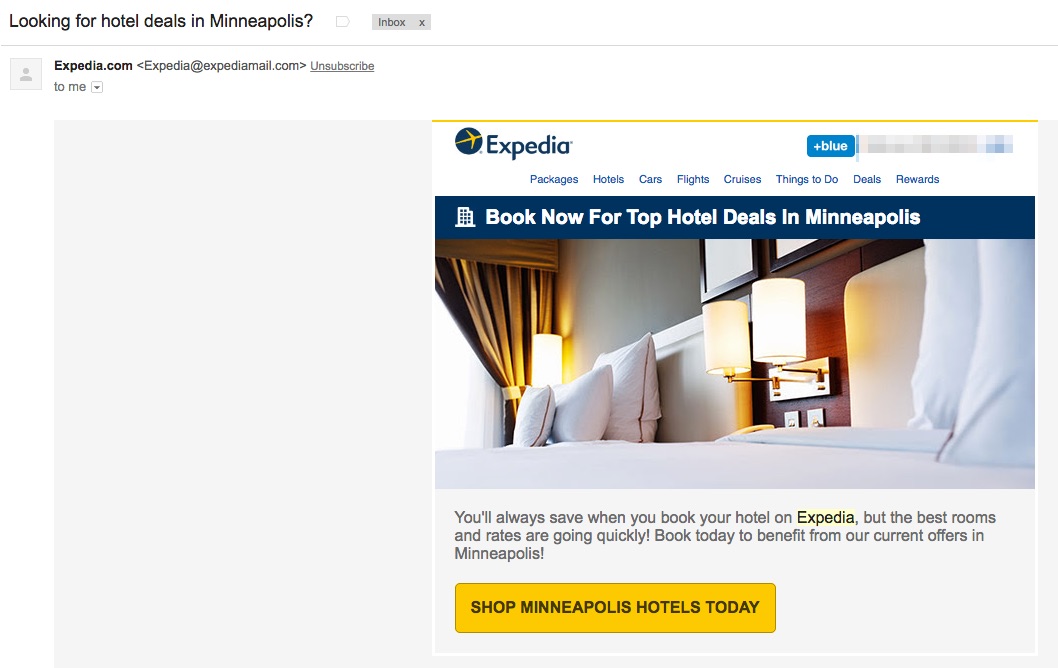

expedia-hotel-deal-email


This campaign successfully executes on message match; aligning what a user was just thinking about and doing on your site with the subject line (that will get their attention), and the email content (to get them to click).


4. Ramit's Warm-Up to Pre-Sell


There's one sure-fire way to learn from other marketers:


Ignore what they say, and watch what they do.


Some of the best digital marketers pull off a sleight-of-a-hand like a Vegas magician; distracting you with one thing over here while they're really laying the groundwork for a powerful move later in the act.


There's no better example of this than Ramit Sethi.


Subscribe to his email list (with a different email or at least some kind of filter) and watch the magic literally unfold.


You'll get tons (and tons and tons and tons) of text-based emails that do everything from grab attention, to engagement and trust building, before finally witnessing these brilliantly executed sales emails.


First, you'll be pre-segmented based on what offer (or where on the site) you opted in. Then you'll receive a mix of content that will switch from the regular ongoing stuff to more choreographed sales efforts.


Typically you can see these coming with an anticipation-inducing “Day 1/X” in the subject line. The copy itself will start layering in social proof (like the number of comments, the number of emails, etc.) before closing with a specific call-to-action to get the reader from passive-to-active.


Here's one good example:
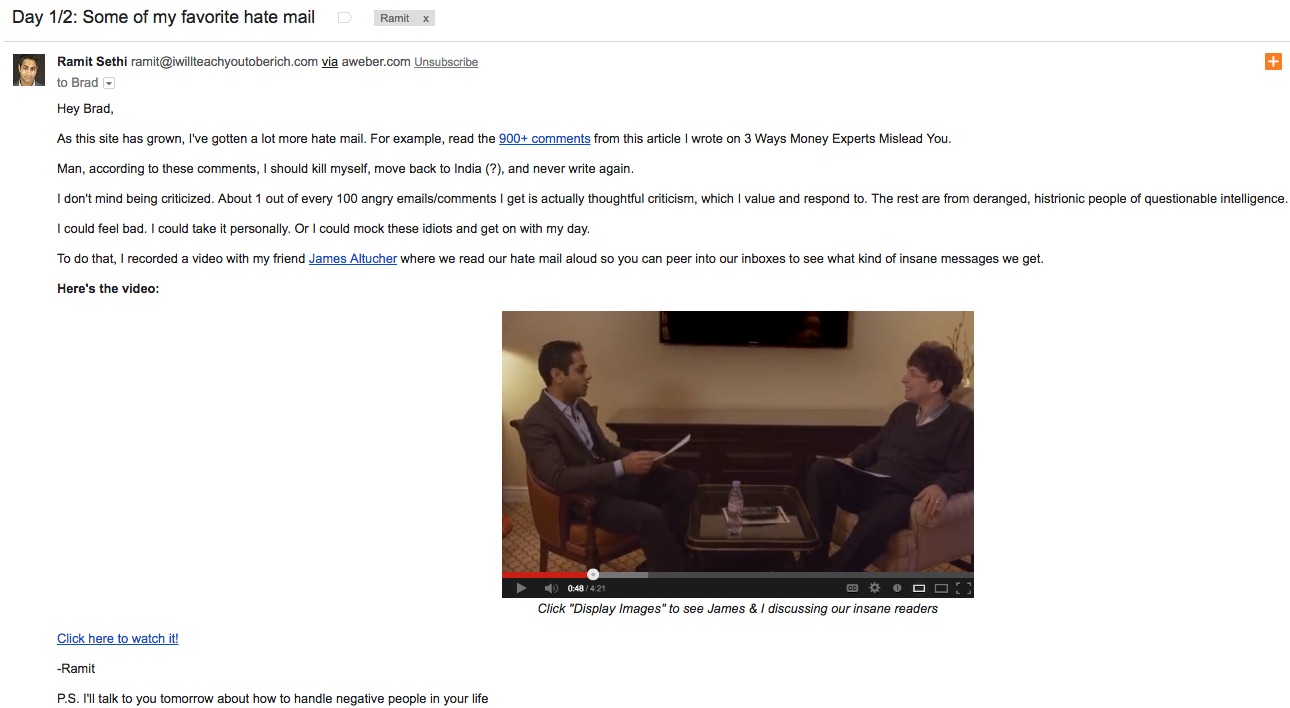

ramit-sethi-hate-mail-email


These start out slow. But watch how they build over the course of a few days (to a few weeks for the larger ones), increasing frequency by as much as 2-3 emails per day and altering the messaging based on if you don't respond, open, or click.


Watching how Ramit seamlessly transitions from focusing on problems and pain points to eventually providing a solution for those should help you not only rethink your email strategy, but all of your content marketing efforts too.


5. Audible's Proactive Churn-Reducing Outreach


Subscription-based services can be profitable. But it usually takes a few months.


They're capital intensive businesses, that require you to front-load cash into soft costs (like salaries, etc.) and hard ones (like advertising, etc.) to acquire customers that pay a little at a time (hopefully turning cash-flow positive within a few months).


A churn rate of 5-7% might be acceptable, but anything greater can quickly send your profitability into a tailspin at an accelerated rate (working almost like negative leverage – see: Bear Stearns).


Audible does a good job sensing or predicting churn and proactively responding to hopefully avoid it.


This promotion gives away something with a high perceived value (even though giving away an extra digital copy of something costs, well, air) to 'win-back' a customer's attention.
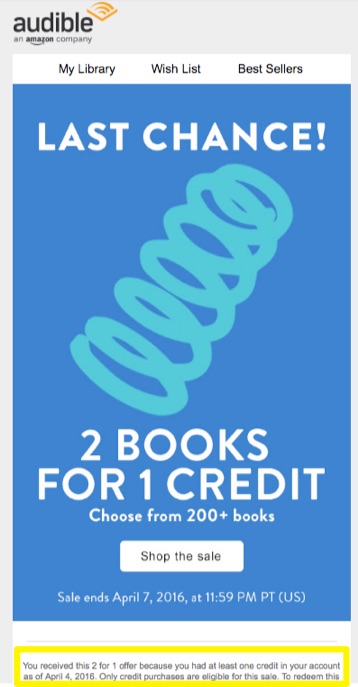

audible-last-chance-email


Highlighted in fine print at the bottom, you can see how they're pulling out a segment of people to receive this special offer (unused credits as of a certain date).


It's simple, but effective.


6. Mint's Important Win-Back Notification


Mint's another subscription-based service, however they don't charge consumers anything up front (instead relying on partnerships, revenue shares and affiliate deals).


That means they really need a sticky model that keeps people for months on end.


Deciding to take out a loan, or switch credit card companies, isn't a decision most consumers make lightly.


They also have this uphill battle at getting people to understand or recognize the problems Mint wants to help you solve (so they can get paid) – when that consumer's need awareness often doesn't exist in the first place.


So… how?
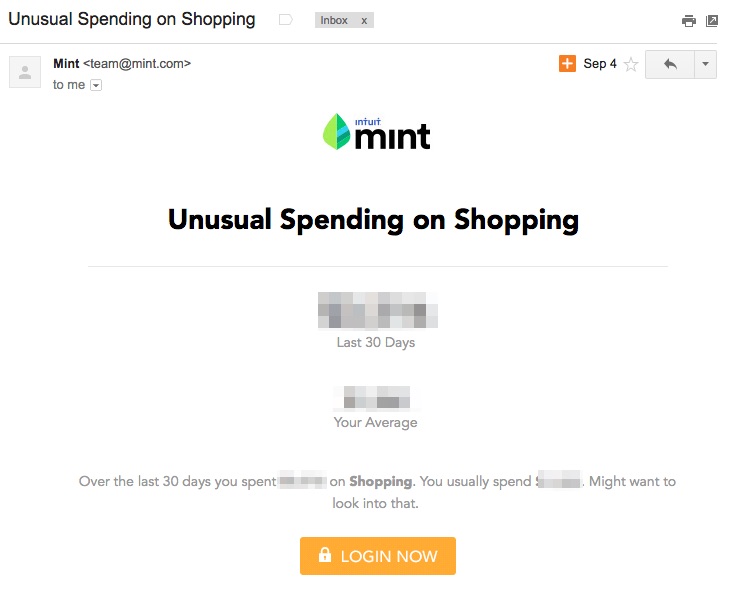

mint-unusual-spending-email


Mint tracks your personalized, historical averages and then sets up notifications or alerts when new aberrations pop up.


Some categories, like spend more on Travel, might be ignored because people are generally delighted to spend there.


However highlighting other frivolous ones, like Shopping, bring up all sorts of insecurities and question marks in someone's head.


The subject line and matching headline act like a cliffhanger; introducing the problem with a suspicious 'power word' (“Unusual”) before directing people to the road to salvation (that big, bright orange “Login Now” button).


7. Salesforce's Trial Expiration Sequence


We've already looked at the dismal statistics of free trialers to paying customers. So let's jump straight into the examples.


This sequence of three emails is being sent to based on the classic example: user (me in this case) logins in on the first day, before eventually failing to login back in or use the product over the next week of the free trial.


So midstream, Salesforce picks up on this and hints at it with the opening line of the email (“I'm guessing you're swamped”).
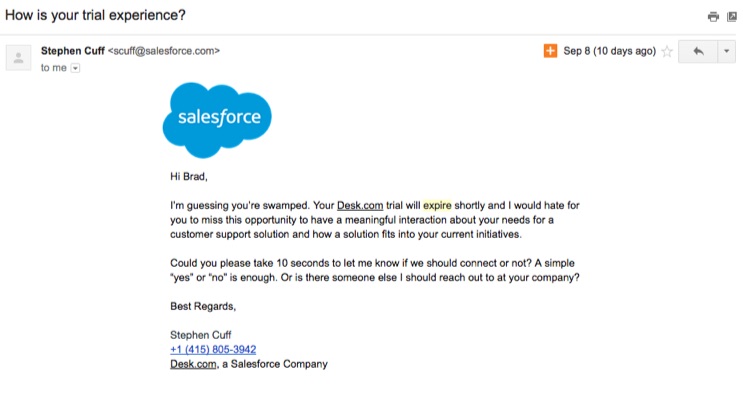

salesforce-trial-experience-email


The messaging around it goes for the soft-sell, trying to elicit some response or engagement of any kind so they can intervene and get you back into the product.


The personalized approach, design, and tone also help make it easy (and low-stress) for someone to reach out and get help (as opposed to 'be sold').


After not responding for a few days, the tone switches to a more direct, hard sell.
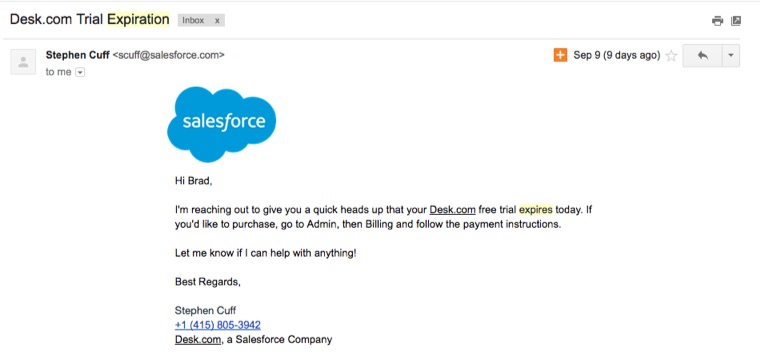

salesforce-trial-expiration-email


Again, the same personalized style is used to get that one-to-one interaction. But this time the language is less friendly and more business (relying on scarcity yet again to drive action).


A few days later (after again not responding), a more generic re-engagement campaign goes with a 'action required'-style subject line, and a message that lets you know there's still time to recover your account and information.
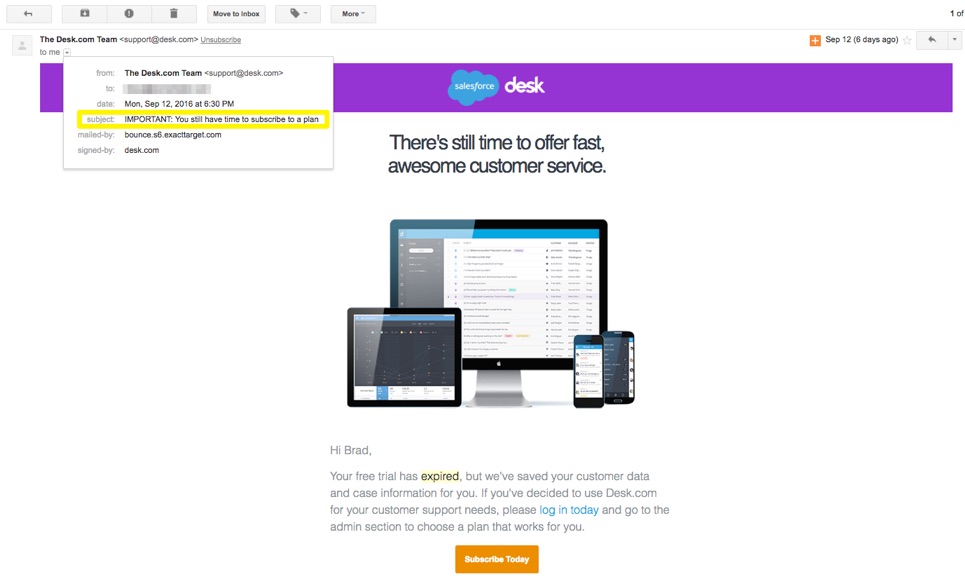

salesforce-reengagement-email


Bonus: Inbound's Personalized Scale Outreach


Each of the examples listed above incorporate clever segmenting and behavior-based techniques to scale personalized emails.


However one of my favorite (and most thought-provoking) examples comes from Inbound.org and Ed Fry that takes this to new extremes.
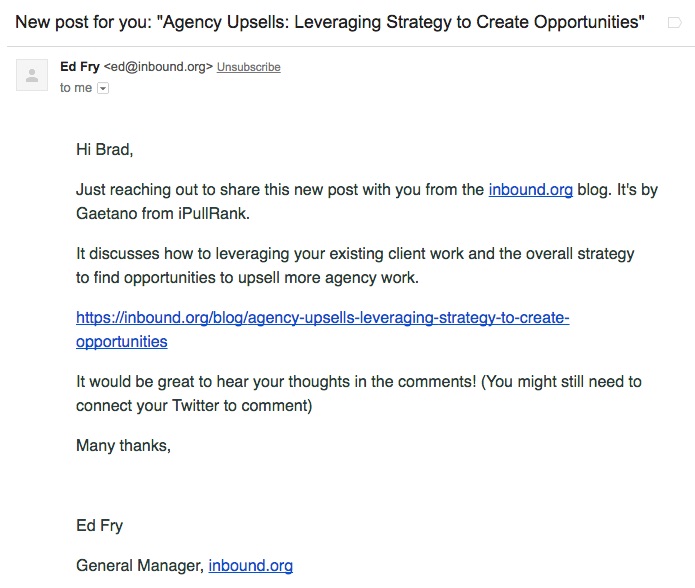

inbound-org-new-post-email


Inbound.org is a community-based site, which is completely dependent on members (of said community) logging in frequently and supplying it with content (posts, answers, interactions, etc.).


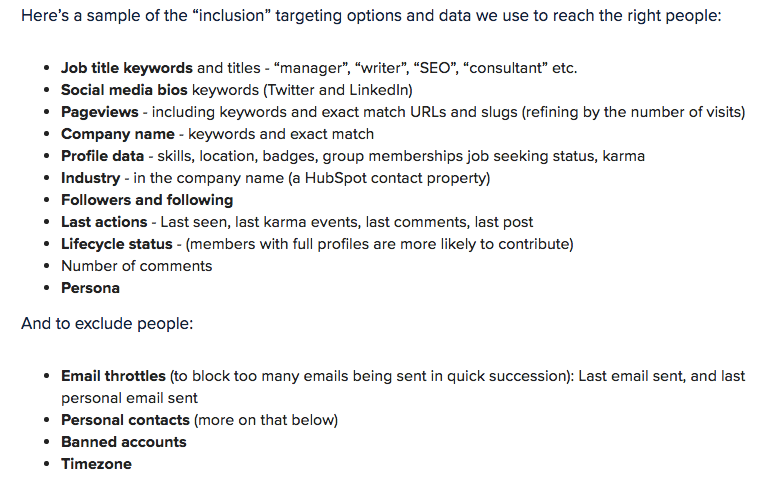
The above email incorporates extreme personalization at scale, using:


  1. My name

  2. My job title / profession (agency)

  3. My level of profile completeness (whether my Twitter is connected)

  4. My engagement (inserting these in between and other emails I receive from them)


Fortunately, Ed was kind enough to share his experience (and results) in running these personalized campaigns.


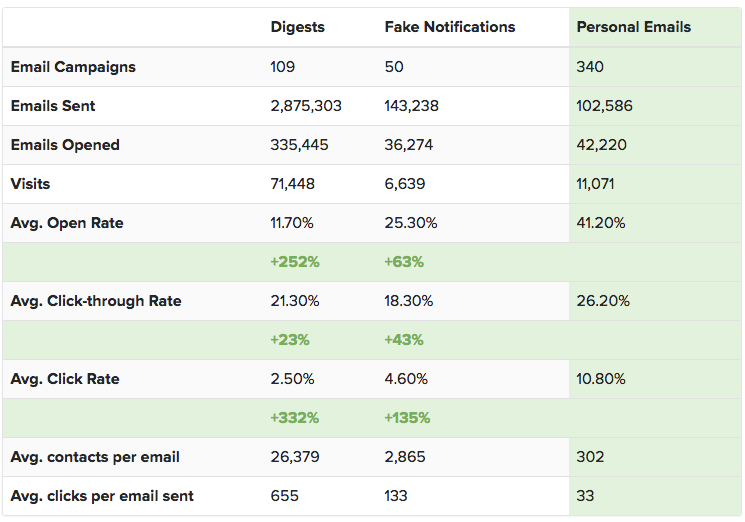
Ed likened these emails to multivariate tests (as opposed to a more general email campaign), because so many variables are at play within a single email (including the question being asked, the targeting, the messaging, and the lists being selected).


Unsurprisingly, incorporating as much specificity as possible reportedly resulted in the best engagement. So they would test subject line & messaging like:


  • Can you help Casey?

  • Can you help Casey's client?

  • Can you help Casey's PPC client?


In order to create campaigns like this, you need a vast amount of customer data (along with the ability to create specialized lists quickly). Here's a sample of what they used to run these:

customer-data-in-email-campaigns
(Image Source)


This extremely personalized approach is time consuming and complicated to pull off. But the results show extreme promise, too.

personalized-email-campaign-results
(Image Source)


Conclusion


Average website conversion rates are a depressingly low 3% in most industries.


Automated email workflows can help dramatically… assuming you're going above-and-beyond the basic, Hey $FNAME.


Instead, some of the best combine nurturing, timing, urgency, scarcity, and extreme personalization to break through the noise, get opened, and get clicked.


Use these seven (+1) examples as a starting point to analyze where your own are falling short, and a model for new techniques to experiment with going forward.


The glass half-full version, is that we have a lot of room for potential.


If the final Inbound.org example is anything to go off of, it's that most of us are still scratching the surface of truly personalized, data-driven techniques that work.


About the Author: Brad Smith is a founding partner at Codeless Interactive, a digital agency specializing in creating personalized customer experiences. Brad's blog also features more marketing thoughts, opinions and the occasional insight.