Wednesday, November 2, 2016

7 Lessons from Top Performing Drip Email Campaigns

Automated email workflows can net you 20% more sales opportunities.


They're more personalized, timely, and targeted.


The problem, is that the vast majority of marketers – as high as 85% – are unhappy with their performance.


Not the results of those campaigns. But of their own execution or implementation of them.


Instead of rehashing the same onboarding campaigns from the same companies that others have covered well, I spent a Sunday morning digging through my inbox to find examples from different industries. (Sounds like a fun weekend, right?!)


The objective, was to pick out different campaigns at random that were each utilizing different personalization techniques to give you a fresh approach and hopefully inspire new ideas.


Here are seven (plus one special bonus) to emulate, research, and try for yourself.


1. Time Etc. Specific Task Spotlight


Tell me if this sounds familiar.


You find (or hear) about a new amazing service.


First pass, it looks awesome. So you sign up, mess around for a few minutes, and… ?


You hit a wall. A blank. And you're not sure what to do next.


There's a reason the vast majority of free trials (~50%) don't turn into free accounts. People aren't sure what to do next, and they haven't seen that 'first win' yet.


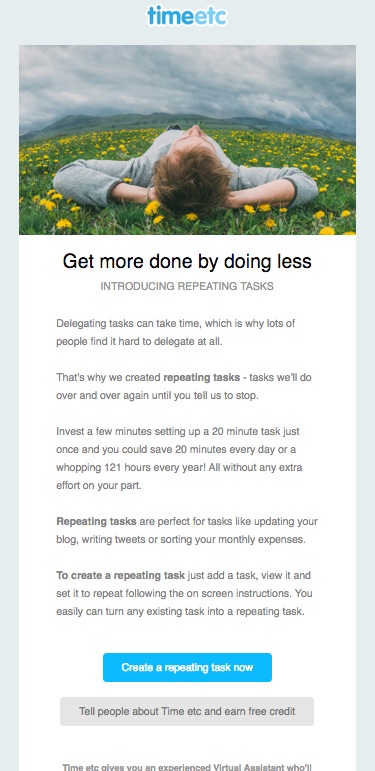
UK-based, virtual assistant service, Time Etc., sends an early task or feature highlight to new sign-ups who haven't used the service yet. The goal is to avoid this decision fatigue by helping to prompt people with specific ideas for what to do next.


For example, this one focuses on creating a new repeating task.

time-etc-repeating-task-email


The single column email is just long enough to provide context to a user, before expertly using a primary (create the task now) and secondary CTA (learn more) to get started.


The hope, is that these leading emails can jog some ideas in those reading it, getting them thinking about ways around the initial problem that blocked them from taking the first critical step in the first place.


2. Rock & Roll's Event Repurchases


The Rock & Roll Marathon Series has grown from humble beginnings in my beloved San Diego, to now stretching out across most major U.S. (and some European) big cities.


They now regularly feature 30,000+ attendees running urban courses with bands, DJs, and more every mile or two of the half and full marathon routes.


As anyone's who's thrown an event can tell you, they rely heavily on early sign-ups (even at discounted prices) and repurchases (from past happy attendees) to help forecast and make up for the fact that most will wait until the very last second (and they've already shelled out the money to organize everything upfront).


That brings up two key segmentation features:


  1. By Location

  2. By Event


Let's start with the basics:


rock-n-roll-marathon-arizona-email


The first example highlights a simple event segmentation, sending a scarcity-based promotional message that would make even Cialdini happy.


This one's relatively straightforward, relying on the urgency of an early pricing discount expiring to be the entire messaging.


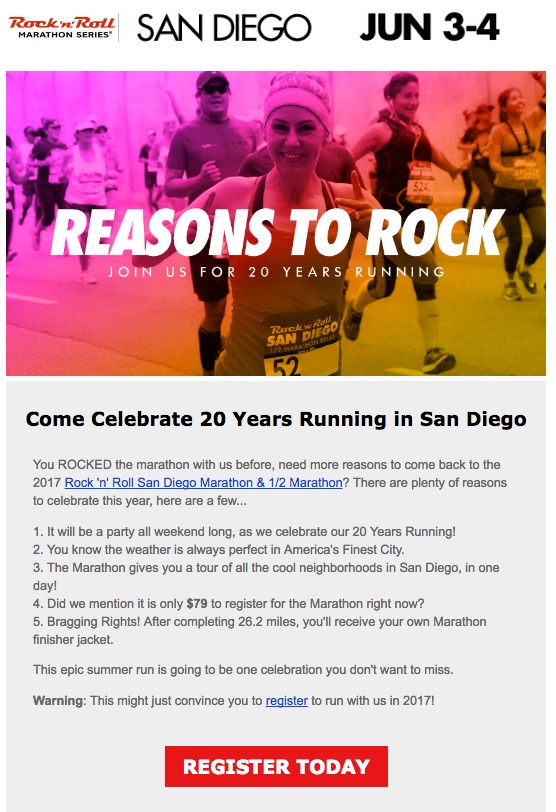
The second is slightly more nuanced.

rock-n-roll-marathon-san-diego-email


This one is pulling in the (1) event and (2) location details to inspire (and hook) those who just completed that specific event in that specific city to repurchase.


Receiving these, in a succession of months, with the aforementioned urgency-based price increases, are like a war of attrition that slowly but surely whittles away a large list to capture as many early purchases as possible.


This example, along with the Time Etc. one before it, was relatively basic time sensitive examples (where campaigns are sent X days out from Y trigger).


Time to get a little more sophisticated.


3. Expedia's Recent Booking Abandonment


A hotel booking process is no different than an eCommerce checkout one when you think about it.


A sample of people begin the process, selecting dates (like products) to see how much the grand total might be, before getting distracted (or jumping over to a different product or website to compare prices) and leave the site.


The statistics are also (unfortunately) similar. While as many as 67% of eCommerce people might abandon a cart, 81% of people booking a hotel or travel might bounce as well.


The good news is if this user's logged in, you can track and react.


Case in point: Expedia sends these behavioral, event-based messages shortly after searching for hotels in specific locations.


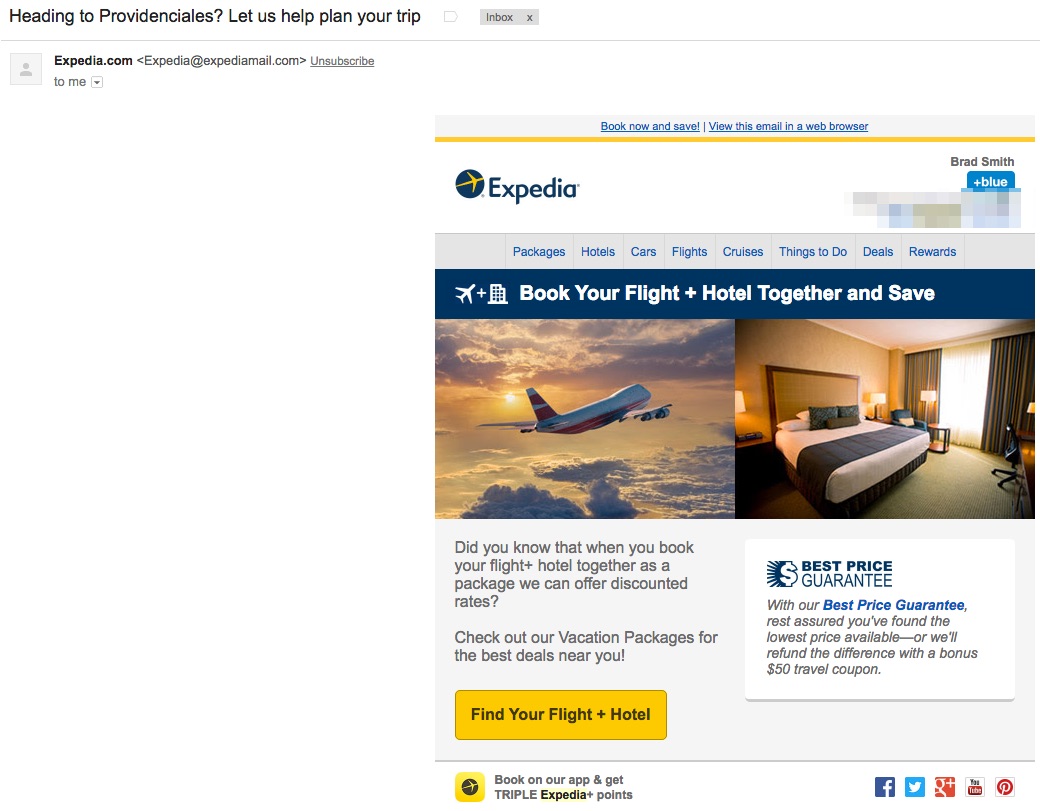
The first example pulls in the specific city name in the subject line of the email, while the body copy tends to be a little more generic, focusing on the 'upsell' of booking an entire package vs. just selecting a hotel.

expedia-recent-booking-email


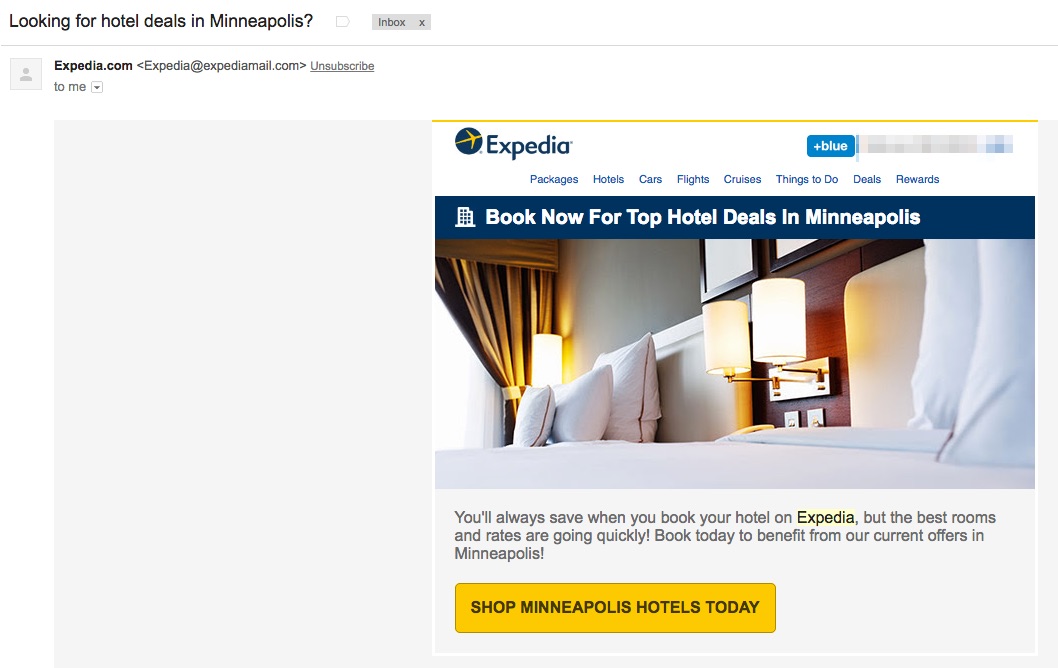
The second, features a subject line that's almost an exact carbon copy of the first (complete with personalized city-name).


However this time, the second one also features a customized message that personalizes the (1) headline, the (2) body copy, and the (3) CTA.

expedia-hotel-deal-email


This campaign successfully executes on message match; aligning what a user was just thinking about and doing on your site with the subject line (that will get their attention), and the email content (to get them to click).


4. Ramit's Warm-Up to Pre-Sell


There's one sure-fire way to learn from other marketers:


Ignore what they say, and watch what they do.


Some of the best digital marketers pull off a sleight-of-a-hand like a Vegas magician; distracting you with one thing over here while they're really laying the groundwork for a powerful move later in the act.


There's no better example of this than Ramit Sethi.


Subscribe to his email list (with a different email or at least some kind of filter) and watch the magic literally unfold.


You'll get tons (and tons and tons and tons) of text-based emails that do everything from grab attention, to engagement and trust building, before finally witnessing these brilliantly executed sales emails.


First, you'll be pre-segmented based on what offer (or where on the site) you opted in. Then you'll receive a mix of content that will switch from the regular ongoing stuff to more choreographed sales efforts.


Typically you can see these coming with an anticipation-inducing “Day 1/X” in the subject line. The copy itself will start layering in social proof (like the number of comments, the number of emails, etc.) before closing with a specific call-to-action to get the reader from passive-to-active.


Here's one good example:
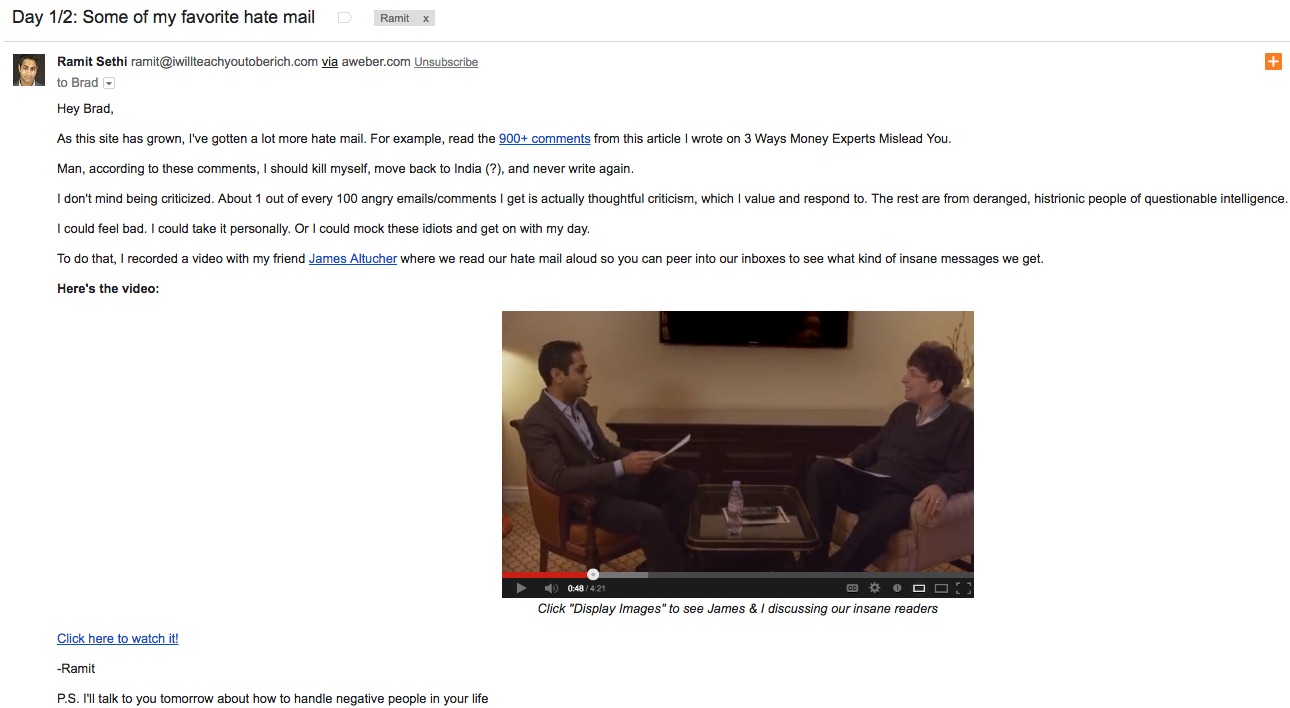

ramit-sethi-hate-mail-email


These start out slow. But watch how they build over the course of a few days (to a few weeks for the larger ones), increasing frequency by as much as 2-3 emails per day and altering the messaging based on if you don't respond, open, or click.


Watching how Ramit seamlessly transitions from focusing on problems and pain points to eventually providing a solution for those should help you not only rethink your email strategy, but all of your content marketing efforts too.


5. Audible's Proactive Churn-Reducing Outreach


Subscription-based services can be profitable. But it usually takes a few months.


They're capital intensive businesses, that require you to front-load cash into soft costs (like salaries, etc.) and hard ones (like advertising, etc.) to acquire customers that pay a little at a time (hopefully turning cash-flow positive within a few months).


A churn rate of 5-7% might be acceptable, but anything greater can quickly send your profitability into a tailspin at an accelerated rate (working almost like negative leverage – see: Bear Stearns).


Audible does a good job sensing or predicting churn and proactively responding to hopefully avoid it.


This promotion gives away something with a high perceived value (even though giving away an extra digital copy of something costs, well, air) to 'win-back' a customer's attention.
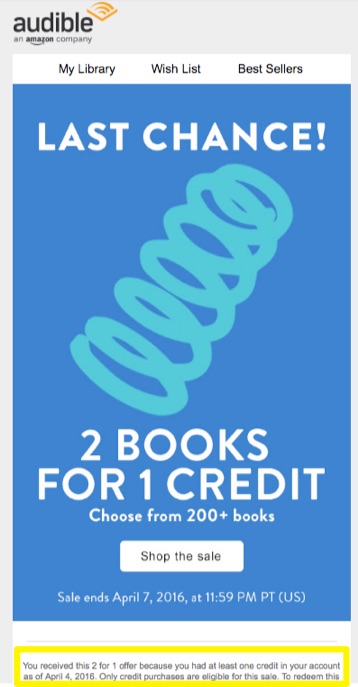

audible-last-chance-email


Highlighted in fine print at the bottom, you can see how they're pulling out a segment of people to receive this special offer (unused credits as of a certain date).


It's simple, but effective.


6. Mint's Important Win-Back Notification


Mint's another subscription-based service, however they don't charge consumers anything up front (instead relying on partnerships, revenue shares and affiliate deals).


That means they really need a sticky model that keeps people for months on end.


Deciding to take out a loan, or switch credit card companies, isn't a decision most consumers make lightly.


They also have this uphill battle at getting people to understand or recognize the problems Mint wants to help you solve (so they can get paid) – when that consumer's need awareness often doesn't exist in the first place.


So… how?

mint-unusual-spending-email


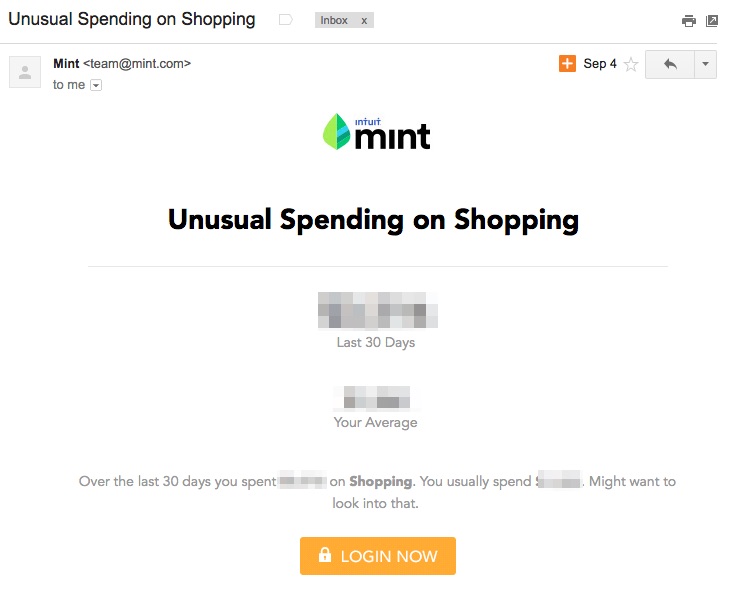
Mint tracks your personalized, historical averages and then sets up notifications or alerts when new aberrations pop up.


Some categories, like spend more on Travel, might be ignored because people are generally delighted to spend there.


However highlighting other frivolous ones, like Shopping, bring up all sorts of insecurities and question marks in someone's head.


The subject line and matching headline act like a cliffhanger; introducing the problem with a suspicious 'power word' (“Unusual”) before directing people to the road to salvation (that big, bright orange “Login Now” button).


7. Salesforce's Trial Expiration Sequence


We've already looked at the dismal statistics of free trialers to paying customers. So let's jump straight into the examples.


This sequence of three emails is being sent to based on the classic example: user (me in this case) logins in on the first day, before eventually failing to login back in or use the product over the next week of the free trial.


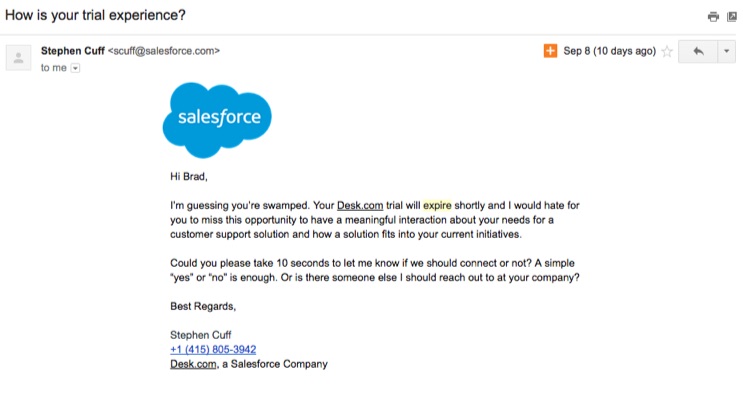
So midstream, Salesforce picks up on this and hints at it with the opening line of the email (“I'm guessing you're swamped”).

salesforce-trial-experience-email


The messaging around it goes for the soft-sell, trying to elicit some response or engagement of any kind so they can intervene and get you back into the product.


The personalized approach, design, and tone also help make it easy (and low-stress) for someone to reach out and get help (as opposed to 'be sold').


After not responding for a few days, the tone switches to a more direct, hard sell.
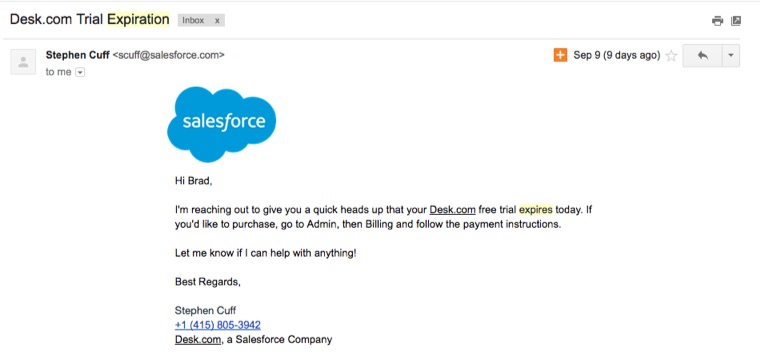

salesforce-trial-expiration-email


Again, the same personalized style is used to get that one-to-one interaction. But this time the language is less friendly and more business (relying on scarcity yet again to drive action).


A few days later (after again not responding), a more generic re-engagement campaign goes with a 'action required'-style subject line, and a message that lets you know there's still time to recover your account and information.
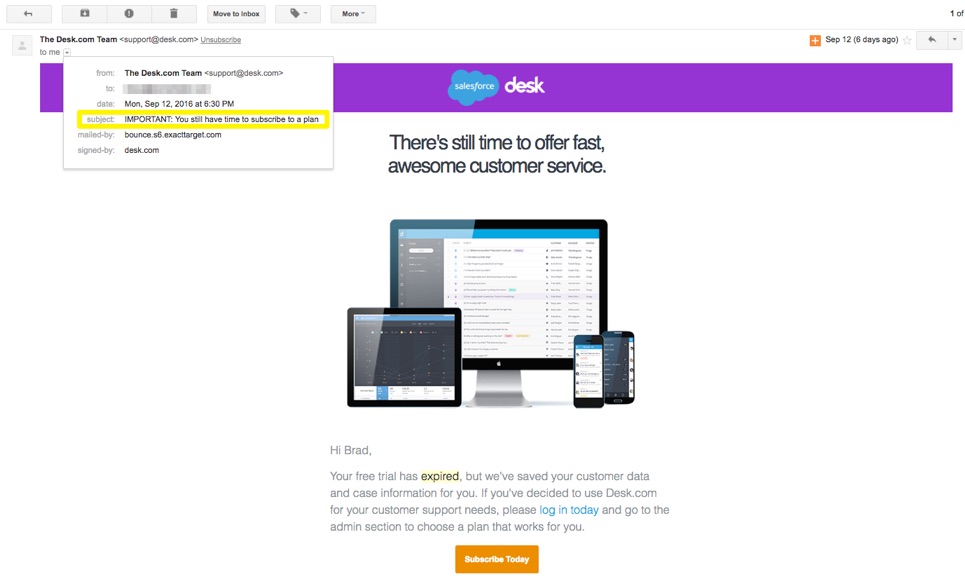

salesforce-reengagement-email


Bonus: Inbound's Personalized Scale Outreach


Each of the examples listed above incorporate clever segmenting and behavior-based techniques to scale personalized emails.


However one of my favorite (and most thought-provoking) examples comes from Inbound.org and Ed Fry that takes this to new extremes.
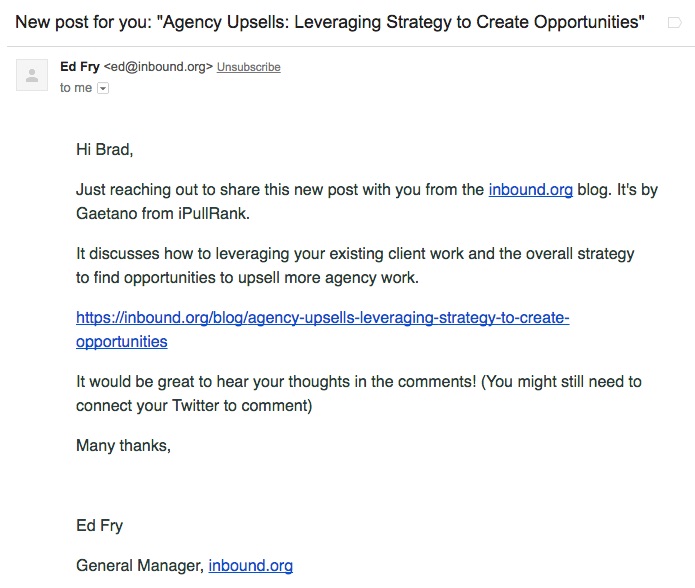

inbound-org-new-post-email


Inbound.org is a community-based site, which is completely dependent on members (of said community) logging in frequently and supplying it with content (posts, answers, interactions, etc.).


The above email incorporates extreme personalization at scale, using:


  1. My name

  2. My job title / profession (agency)

  3. My level of profile completeness (whether my Twitter is connected)

  4. My engagement (inserting these in between and other emails I receive from them)


Fortunately, Ed was kind enough to share his experience (and results) in running these personalized campaigns.


Ed likened these emails to multivariate tests (as opposed to a more general email campaign), because so many variables are at play within a single email (including the question being asked, the targeting, the messaging, and the lists being selected).


Unsurprisingly, incorporating as much specificity as possible reportedly resulted in the best engagement. So they would test subject line & messaging like:


  • Can you help Casey?

  • Can you help Casey's client?

  • Can you help Casey's PPC client?


In order to create campaigns like this, you need a vast amount of customer data (along with the ability to create specialized lists quickly). Here's a sample of what they used to run these:
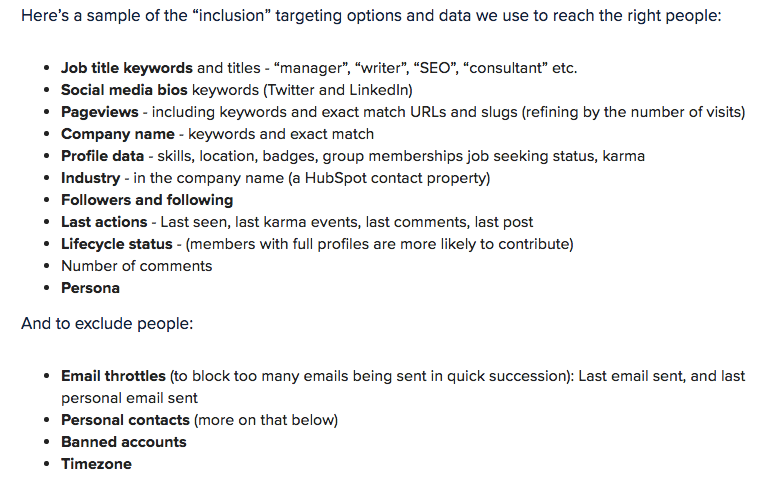

customer-data-in-email-campaigns
(Image Source)


This extremely personalized approach is time consuming and complicated to pull off. But the results show extreme promise, too.
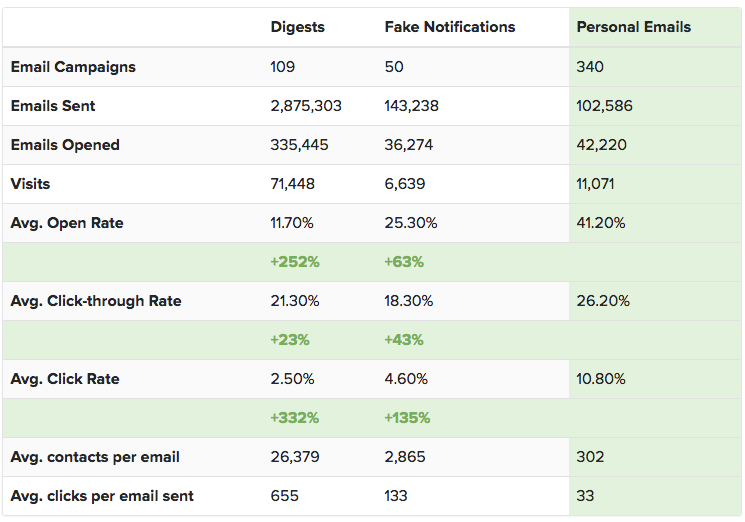

personalized-email-campaign-results
(Image Source)


Conclusion


Average website conversion rates are a depressingly low 3% in most industries.


Automated email workflows can help dramatically… assuming you're going above-and-beyond the basic, Hey $FNAME.


Instead, some of the best combine nurturing, timing, urgency, scarcity, and extreme personalization to break through the noise, get opened, and get clicked.


Use these seven (+1) examples as a starting point to analyze where your own are falling short, and a model for new techniques to experiment with going forward.


The glass half-full version, is that we have a lot of room for potential.


If the final Inbound.org example is anything to go off of, it's that most of us are still scratching the surface of truly personalized, data-driven techniques that work.


About the Author: Brad Smith is a founding partner at Codeless Interactive, a digital agency specializing in creating personalized customer experiences. Brad's blog also features more marketing thoughts, opinions and the occasional insight.


Trust These 5 Customer Experience Lessons from Eating Sushi

Customer experience is all about the interactions between customers and brands. These days many brand focus on this experience across online and offline channels, but these are some thoughts on any interaction between a customer and a brand.


Brands stand for something, or they represent something in the minds of consumers, and the result of every experience is how well the brand lived up to those expectations. The more times a brand meets those expectations, or even exceeds them, the more loyal a consumer becomes.


Think about your favorite brands: cars, clothes, toothpaste, restaurants, sneakers, airlines. You know what to expect and usually you get it. Remember that time your toothpaste added crystals and it just wasn't the same. You even thought about changing to another brand.


I recently had lunch at a sushi restaurant while traveling and sat at the counter. This gave me great insight into how they think about customer experience.


1. Trust Me

We are used to making choices in restaurants. We pick the food that we like. But in this restaurant we are encouraged to follow the chef's selection. It is actually called the Trust Me menu. Our only choice is small, medium, or large, which determines the number of items you get. Whether you know about this menu before you arrive, you are encouraged to put your full trust in the chef to serve food that you will like.


When was the last time that your customers put their full trust in you for selecting what they should purchase from you? Think about what it would take to earn that level of respect from your customers.


2. Trust Me Even More

There is a note on the menu that says you should consume your food exactly as it is served. No extra salt. No extra sauce. No extra rice. Again, this is an even more granular level of trust and respect for the chef. Not only does he know what is best for you, but he recommends that you don't make any changes to what he has provided.


Customers make all kinds of modifications to products they purchase from us. Can you set customer expectations that the experience you are providing cannot be improved upon?


3. We Are Doing Our Part

The chef has said here's what you should eat and how you should it, but he takes it one step further. He tells you when you should eat it. Immediately. This is food prepared very precisely and served that way. Every dish is a mix of temperatures and textures that will change with time. Because of this, every server is moving fast. Food doesn't sit in the window. It comes up and goes out. This is not so unusual in many restaurants, or even most restaurants, but if you're getting 7-10 small plates served individually and at a certain time, that's a lot of serving.


Are you doing absolutely everything you can to hold up your end of your customers' expectations? If they are putting their trust in you, are you really doing your part?


4. Preparation is the Key

This level of service is not an accident. There's no way to serve all these plates without a great deal of preparation. Nothing is left to chance. That goes for all the ingredients, plates, even people. I'm sure this restaurant was just as busy in preparation in the hours before lunch as they were during lunch.


If your customers showed up to your business an hour before your meeting or two hours before you opened to the public, what would they find? Are your people paying just as much attention to preparation as they are to your customers?


5. Instant Gratification is Just That

As soon as I placed my order, my server put a bowl of edamame in front of me. This took the edge off my hunger and gave me something to do while waiting for my food. It also prevented me from wondering where my food was. This made me happy and distracted. And there was no fear of filling up on soybeans. My parents always warned us kids not to fill up on bread.


Do you have something that you can give your customers immediately upon their purchase, assuming that they are not walking out the door with their purchase? This is exactly the kind of thing that influences their experience and keeps them loyal.


Another question you should ask is who should be in charge of the customer experience. The latest trends indicate the chief marketing officer should be. Constellation Research agrees in their report Should the CMO Oversee the Whole Customer Experience? Download it today.


How to Use Psychology to Maximize Social Engagement

What if there was a magic formula for social media marketing?


A formula that would allow you to snap your fingers while saying “Presto!” and have your audience instantly engaged with your content. Next thing you know, they follow, share, and leave comments.


Well, there is (sort of).


But instead of snapping your fingers, you use scientifically-backed psychological principles to maximize social engagement.


You can think of it as neuromarketing, defined as:


“the process of researching the brain patterns of consumers to reveal their responses to particular advertisements and products before developing new advertising campaigns and branding techniques.”


I've been fascinated with neuroscience for a while. Why? Because this stuff just works.


One of my favorite resources to make was the one on consumer psychology:


image01


When I dug into the research, I started realizing people act in predictable ways. And then I realized that certain marketing messages could increase the likelihood of peopling acting in such ways.


Instantly, it made my job as a marketer way more interesting. I began researching all the ways I could apply these principles to blog articles, ad spend, videos, and, yes, social media.


By understanding a few key cognitive processes, you can drive social engagement and increase the effectiveness of your overall social media marketing campaign.


Here are some specific strategies you can implement right away.


The halo effect


This term halo effect originated nearly 100 years ago in 1920, when researcher Edward Thorndike conducted a study where “two commanding officers evaluated their soldiers in terms of their physical qualities (like neatness, energy and physique) and their mental, emotional and social qualities (like intellect, leadership and responsibilities).”


“Thorndike found that, if one of the soldier's qualities was rated highly, the other qualities tended to also be rated highly, and vice versa.”


How does this relate to social media marketing?


It's very simple.


If you establish your brand as having one positive trait, consumers are more likely to believe that your other qualities are more positive as well. In other words, they subconsciously form a positive bias.


Here's an example. Say you build a reputation for posting top-tier, high-quality, thought-provoking articles on Twitter.


In turn, your audience views your brand as being more intelligent and competent.


This should spill over into other areas, and your audience will be more likely to think of your products/services and customer service as being high-quality as well.


The bottom line is that if you can kill it in one area, it's easier to improve your overall public perception and thrive in other areas.


Consumers are more likely to trust your brand and will be more inclined to engage with you on social media.


Post what's most commonly shared


What's one of the primary goals of posting content on social media?


To get people to share it with their friends and followers.


But posting content blindly, without any rhyme or reason, is like throwing darts blindfolded. You're just hoping and praying that something hits the target.


Fortunately, there's a shortcut to maximizing shares.


All you have to do is post what other people share the most.


According to a study from a well-known market research company Ipsos,


“Global citizens who indicate they have shared some type of content online on social media sites in the past month seek primarily 'to share interesting things' (61 percent), 'to share important things' (43 percent) and 'to share funny things' (43 percent).”


Understanding people's sharing habits drastically increases your chances of hitting your target and boosting social engagement.


This isn't to say that every single piece of content you post that's considered interesting, important, or funny will be wildly successful, but this does give you a general framework to build on.


Here's a more detailed graph that provides even more insight into social media users' sharing habits:


image00


If you wonder what type of content is most likely to resonate with your audience, this graph can definitely help guide your efforts.


Give your audience something free


Here's another psychological tactic you can use to your advantage.


Give away something your audience deems as being valuable, and they'll feel indebted to you.


This phenomenon relies upon the concept of reciprocity, which says that humans feel inherently obligated to repay someone when that someone does them a favor, helps them out, or gives them something.


And this doesn't have to be anything huge.


I'm not saying you have to give away a fifty-dollar-product to your social media followers to get results.


It can be something quite small as long as it's legitimately valuable.


Here's a great example:


Anytime Fitness gave their Facebook followers a free downloadable calendar to plan and monitor their exercise activities to ensure they met their fitness goals.


image02


You could give away an e-book, whitepaper, month-long subscription, or anything else your audience would find valuable.


This simple yet effective technique subconsciously makes people want to return the favor, which can come in the form of more followers, more shares, and positive publicity.


Use social proof to create leverage


Peer pressure doesn't disappear after high school.


Even as adults, we're susceptible to it to some extent.


You can use peer pressure to your advantage from a psychological standpoint by creating social proof.


If you're unfamiliar, social proof is defined as “the concept that people will conform to the actions of others under the assumption that those actions are reflective of the correct behavior.”


The premise is quite simple. You find ways to prove to potential followers or customers that your brand is awesome.


It follows then that when people see that others are digging your brand, they will feel they should too. Luckily, social media is an ideal medium for creating social proof.


Here are some specific ways you can maximize social engagement:


  • Try to get an industry expert to link to one of your blog posts on their profile.

  • Post a picture of a notable figure or celebrity using your product.

  • Encourage customers to share photos of your product.


Here's an example of when a Snapchat celebrity Shaun McBride (a.k.a. Shonduras) let Taco Bell take over his Snapchat account to promote the launch of their Cap'n Crunch Berry Delights.


image04


These are just a few ideas, but the possibilities are nearly endless.


Just look for ways to have others give your brand a collective nod of approval, and your engagement should grow along with your leads and conversions.


Incorporate nostalgia


As someone who grew up in the 90s, I get a little sentimental when I think about things like the original Nintendo, Goosebumps books, super soaker water guns, and Nickelodeon's green gak.


It brings back fond memories:


image05


Whether the past was actually as good as we remember is irrelevant. The majority of people look back at yesteryear, and their childhood in particular, through rose-colored glasses.


What does this mean from a social media standpoint?


It means that incorporating nostalgia into your campaign can significantly increase social media engagement.


Robert M. Brecht, Ph.D., wrote an article explaining the effectiveness of nostalgia in marketing.


According to Brecht,


Marketing research clearly shows a positive resonance with both nostalgic ads and the products advertised. It even shows more persuasive influence on customers.


He also made reference to a specific study and said that:


It indicates that when consumers experience nostalgia in a consumption context, they have a higher purchase likelihood with regard to the advertised products.


If you can incorporate nostalgia into your social media marketing, you can trigger a powerful psychological response, which should translate into higher engagement levels.


For example, you might jump on the #throwbackthursday hashtag on Twitter and post something that's retro.


Or you might post pictures on Instagram that show what products in your industry looked like 20 or 30 years ago.


There are many different avenues you can take with this approach.


Create scarcity


One of the greatest fears for most people is the fear of missing out (FOMO).


We naturally want to “be in,” and the thought of missing out on something epic scares us.


That's why the scarcity principle can be so incredibly effective.


After all, why do you think there are so many companies that use terms such as “while supplies last” or “limited time offer?”


Here's an example that proves the power of scarcity brilliantly. A study by “researchers Worchel, Lee and Adewole asked participants to rate two jars of cookies. At first, both jars contained 10 of the exact same cookie.


Then from one jar, eight cookies were removed (making them more scarce). Now participants had to choose between the jar with 10 cookies or the jar with only two left.”


The jar with only two cookies was chosen much more often than the jar with 10 cookies.


In other words, scarcity sells.


image03


If you're really looking to boost engagement, create scarcity.


Make it abundantly clear that if social media users don't take action immediately, the opportunity will be lost forever.


For example, you might have a deal where people who “Like” your Facebook page will be entered into a contest to receive a prize. But they have a limited amount of time to do so.


This tactic will trigger many people's FOMO response, and they'll take action.


Conclusion


Psychology is a social media marketer's best friend.


There are several psychological principles you can implement into your social media campaign that will drive engagement and elicit a response from your audience.


This is important because it helps you get the most from your efforts and ensures the content you post doesn't fall on deaf ears.


By providing a bit of motivation and encouragement, you can build a more engaged audience that's highly responsive.


The long-term benefits?


More follows, comments, shares, and, ultimately, more quality leads coming to your website.


How much of a role does psychology play in your social media marketing?


LinkedIn can now help you figure out the salary you deserve

Https%3a%2f%2fblueprint-api-production.s3.amazonaws.com%2fuploads%2fcard%2fimage%2f268864%2flinkedin_premium_image
Feed-twFeed-fb

For all of LinkedIn's career-building tools, one area where the professional network has fallen short is in helping shed light on the black box that is salary information. That is now changing.


The company introduced a new tool called LinkedIn Salary that aims to help users learn more about the salaries in their industry and how making changes to their current career impacts how much they make.


Enter a job title and a city and the tool turns up results showing the median earnings for individuals with that job title in the city you selected. Besides base salary, it also takes into account other forms of compensation, like bonuses and stock options. Read more...

More about Glassdoor, Linkedin, Social Media, Apps And Software, and Tech


The 20 Minute Twitter Audit

You want to analyze the performance of your Twitter account, but don't want to spend three hours doing it. You're not alone. A Twitter audit isn't at the top of most marketers' list of fun things to do for the day. But it has to be done.


Luckily there's no rule that says a Twitter audit has to be excruciating or can't be done in under an hour. If you're efficient and organized, you can run a successful Twitter audit with all of the data you need in as little as 20 minutes.


What Is a Twitter Audit?


A Twitter audit is a diagnosis of your Twitter account's performance. During a Twitter audit, you want to look at your Tweets, followers and the overall branding of your account.


The goal is to find any weaknesses or holes in your account, and potential opportunities for improvement. For social media marketers, a lot of focus gets put on growing your account, getting more followers on Twitter and increasing traffic. But unless you're taking a second to audit everything you're doing, it's difficult to gauge whether or not you're making the right decisions.


So the question is where do you start? Here's how to perform a complete Twitter audit in less time than it takes to have a pizza delivered.


We broke the process down into three easy steps:


  1. Auditing your Tweets.

  2. Auditing your followers.

  3. Auditing your profile and branding.


Auditing Your Tweets


We'll start by auditing your Tweets. Keep in mind that you can customize the process to fit your needs.


Step 1: Gather Your Data


The first thing you need to do is get your data together. If you're gathering data from multiple tools, you'll want to combine it all into a single document. For this guide, we'll show you how to get the data for your audit from Twitter's native platform and Sprout's Twitter analytics.


Here's how to extract data from Twitter:


  1. Log into your dashboard and select the Tweets tab.

  2. Set your date range.

  3. Click “Export data.”


export twitter analytics

Twitter will give you a spreadsheet with details like engagement, stats for your promoted Tweets and more. If you have multiple Twitter profiles, you need to do this process for each account then combine everything into a single spreadsheet.


The second option is to use Sprout Social. One of the biggest benefits of using Sprout is you can access data for all your profiles in an instant. This prevents you from having to export reports for each profile one by one. Sprout also allows you to put everything into one spreadsheet.


Here's how to extract your Twitter data from Sprout:


  1. Open your Sprout Social dashboard and navigate to the reports tab.

  2. Click on your Sent Messages report to see data on a Tweet level.

  3. Select the time frame (the larger the window the more data to analyze).

  4. Select the Twitter profile you'd like information on and Export CSV.


twitter report sprout social

You'll receive a neatly organized spreadsheet of your sent Tweets. Specifically, you'll see:


  • The date and time each Tweet was sent

  • The profile for each Tweet

  • Which team member sent the Tweet

  • A link to the Tweet on Twitter

  • The message

  • Any targeting options you selected

  • Clicks

  • Reach

  • Retweets

  • Replies

  • Likes

  • Impressions


Sprout's reports are ideal for companies that have multiple people managing their Twitter marketing. Your report shows who sent each Tweet, which makes it easy to track and measure individual performance.


Step 2: Choose Your Goals


Now you have a bunch of data to go through. But before you do a deep dive, you need to know what you're looking for. So you need to define your goals for the audit. Then match those goals to metrics you can track.


When it comes to auditing Tweets, you'll most likely be looking at engagement. But under the umbrella of engagement, there are several different metrics you can track:


  • Likes are a way for Twitter users to show they appreciate your post. Some may think of Likes as a vanity metric, but they're an indicator that someone enjoys the content you're sharing.

  • Retweets are similar to Likes in that they show someone enjoys your content, except they are a little stronger of a signal. A Retweet means a person enjoyed your post so much they decided to share it with their own followers.

  • Replies are messages people send to you in response to one of your specific Tweets. These can be positive, negative and neutral, so make sure you're looking at the sentiment of replies instead of just the quantity.

  • Clicks count as when someone clicks on a link that you Tweeted. This is typically one of the top metrics for social media marketers, since driving traffic is one of your top goals.


In addition to engagement, some brands like to measure reach or impressions. Reach is all about how visible your Tweets are.


twitter analytics report

As Twitter users share your messages with their own audiences, it will be seen by even more people. This leads to an increase in your overall reach, or the amount of people who have seen one of your messages. This metric is important for marketers focusing on branding and awareness.


All of these metrics are meant to help you determine which Tweets perform the best so you can share more of the content your audience resonates with. Without doing a Twitter audit, it's difficult to pinpoint Tweets or content that works best for your audience.


Taking time to review your Tweets on an ongoing basis will give you a lot of great insights.


Step 3: Review the Data


We have the data and we know what we're looking for. The next step is to review it all in your spreadsheet.


Keep your goals in mind when you're looking through your reports. It's best to sort your data based on your goals. For instance, if you want to increase your Twitter referral traffic, organize your spreadsheet by Tweets with the most clicks. Then you can see exactly which are your top performers.


Take notes on your best performing Tweets. For instance:


  • The type of Tweets: Pics, videos, links etc.

  • Copy: Are you asking questions? Or maybe there's a particular sentence structure that works well.

  • Hashtags: What hashtags are you using, and how many?

  • Mentions: Do your top Tweets mention influencers or specific accounts?


It's easy to fall into the trap of analysis paralysis while doing a Twitter audit. Particularly if you're sorting through hundreds or even thousands of Tweets. By defining what you want to look for before you start looking through spreadsheets, you'll be able to streamline the audit.


Auditing Your Twitter Followers


Knowing who's following you will help you produce content that's more tailored toward your audience. Sometimes when your Tweets aren't getting as much engagement as you'd like, it's because there's a disconnect between what you're sharing and what your audience wants to see. The first step in fixing that problem is analyzing who's following you.


We wrote an in depth guide on how to analyze your Twitter followers. We highly suggest reading that post to help with your Twitter audit. But we'll break down some of the key points here and a few extra things to consider.


The main things you want to look at during your audit are:


  • How many fake followers you have.

  • What your followers Tweet about.

  • When your followers are most active.

  • Any influencers following you.

  • Your top brand advocates.

  • Follower demographics.


Luckily you can get all of this data using just a couple of tools.


To find your fake followers, you can use a tool like this. It'll give you an estimate of how many bots are following you. If you end up having a ton of fakes, read our guide on getting genuine followers.


Twitter followers audit

You can use Sprout to get the rest of the data. For instance, our Trends report shows your top brand advocates on Twitter.


people and brands frequently talking about report

You can also see your audience demographics in our Twitter Profiles report so you know who's following you.


audience demographics sprout social

Put all of this information into a spreadsheet and develop a profile for your average follower. You can be as detailed as you'd like, but just make sure you're only including useful information. If it won't help you improve your Twitter strategy, you can leave it out.


Use Twitter's native analytics to get even more demographics about your audience.


twitter audience metrics

Some of the main points to include are:


  • Demographics (age and gender).

  • Psychographics (interests and behavior).

  • List of your top brand advocates and influencers following you.


Auditing Your Profile & Branding


Last but not least, you need to audit your Twitter profiles. That includes things like checking your bio, URL and even profile picture. Your Twitter profile shouldn't be the same as it was five years ago. As your brand grows and changes, you should update your Twitter profile to reflect that.


Start by making sure all your profile graphics are correctly sized because Twitter occasionally changes its image dimensions. If you go years without ever touching your profile, there's a chance your current header or profile picture needs to be updated.


Even if the sizing is correct, the image itself might need a refresh. Check our social media images size guide for the current sizing.


twitter image sizes

Next, look at your Twitter profile link. While most brands link to their home page, others like to use the space to link to a particular campaign or social media contest. If you were using your Twitter profile link to push traffic to a contest that already ended or other old content, this is the perfect time to change it. The worst thing you could do is link to a page that's outdated or irrelevant.


The last part of your profile to look over is your bio. Ask yourself these questions:


  • Does my bio represent my brand?

  • Is it clear what my company does?

  • Does my bio compel people to take action?


Twitter bios are often an underutilized part of Twitter profiles. One of the first things people see when they find you on Twitter is your bio, so make sure to create a great first impression. Notice how our bio clearly describes what is Sprout Social, and even includes a strong CTA for a free trial.


sprout social twitter profile

You could even try testing out different bios and measure the success of each variation. Use a trackable URL like the Bitly link in our bio above in order to measure your traffic.


Twitter Audits Don't Have to Be Horrible


This quick and simple process will allow you to do a Twitter audit that gives you valuable data without spending hours of your day creating and analyzing reports.


The goal of a Twitter audit isn't just to gather a bunch of data that sits around on your computer for months. It's to help you spot new opportunities and improve your strategy. Turn your audit into actionable steps you can take to grow you audience and get more from Twitter.


This post The 20 Minute Twitter Audit originally appeared on Sprout Social.


Could Social Media Drive Turnout of Young Voters?

Social media has made a big impact on election cycles in the U.S. While social media can reduce polarization, it can also become a check on politicians or a mouthpiece for political agendas. One area where social networks are having a positive impact is on potential voter turnout, as several sites increase their get-out-the-vote efforts.


Just last week, Twitter partnered with Pew Research Center and Google in an effort to disseminate information about polling place locations and ballots. YouTube partnered with its Creators to build a campaign urging users to register to vote, and it also livestreamed the presidential debates on behalf of PBS, Telemundo and The Washington Post, among others.


However, some of the biggest impacts have been a result of efforts from Facebook. According to Gizmodo, Facebook has conducted clandestine experiments in recent election cycles,  which have influenced hundreds of thousands of potential voters to register for upcoming elections.


The New York Times reported that Facebook's “Are you registered to vote?” campaign has  prompted similar surges in registration this year. The Times added that Facebook also plans to remind users to vote on Election Day, as it has during each election since 2008.


With these efforts, it's clear that social media has immense power to motivate young voters–a group traditionally seen as less engaged with elections. When social networks implement these initiatives, they meet young voters where they already spend significant amounts of time. Simple reminders, or more complex user-led initiatives, are having a major impact on the electoral process.


Image courtesy of Shutterstock.


Tuesday, November 1, 2016

Journalism 101, Facebook-Style

Facebook last week launched a series of online courses for journalists via its Blueprint global training program.


Manager of journalism partnerships Áine Kerr wrote in a blog post that the e-learning courses will focus on the “three core pillars” of the news cycle-discovering content, creating stories and building an audience-adding that best practices and guidelines from Facebook are meshed with case studies from journalists.


Kerr said courses available at launch include “How Journalists Can Best Utilize Facebook and Instagram,” as well as installments on Facebook Live, 360 videos and photos and Instant Articles, adding:


In addition to the Discover, Create and Engage modules, we have included a guide for journalists that will explain how to get started on Facebook or simply grow your presence. We've heard from journalists that they need more information when deciding between setting up a page or a profile and about how to manage privacy settings. The “Getting Started” course seeks to answer all of those questions and covers key steps for building out a professional journalistic voice on the platform, including how to apply for the Facebook blue badge that indicates verification.


In the coming weeks, we will also commence a series of webinars on the site, which will be tailored to journalists who are both new and old to Facebook. These webinars will be organized according to new products and features, a person's level of experience using Facebook as a journalist and their role (newsgatherer, content creator or audience engagement specialist).


Journalists: Will you take advantage of these resources?


FacebookBlueprintJournalists